

Video keeps getting easier to produce—and harder to stand out with. Audiences scroll faster, platforms reward different formats, and AI tools are changing how creators plan, script, edit, and distribute content. If you’re using video to educate, sell, recruit, or build trust, the numbers matter because they reveal what people actually watch, where they watch it, and what influences results.
The stats below highlight the choices that shape performance: which video formats are gaining traction, what lengths tend to work, where viewers are spending time, how marketers track ROI, and how shifts in AI and advertising are affecting distribution.
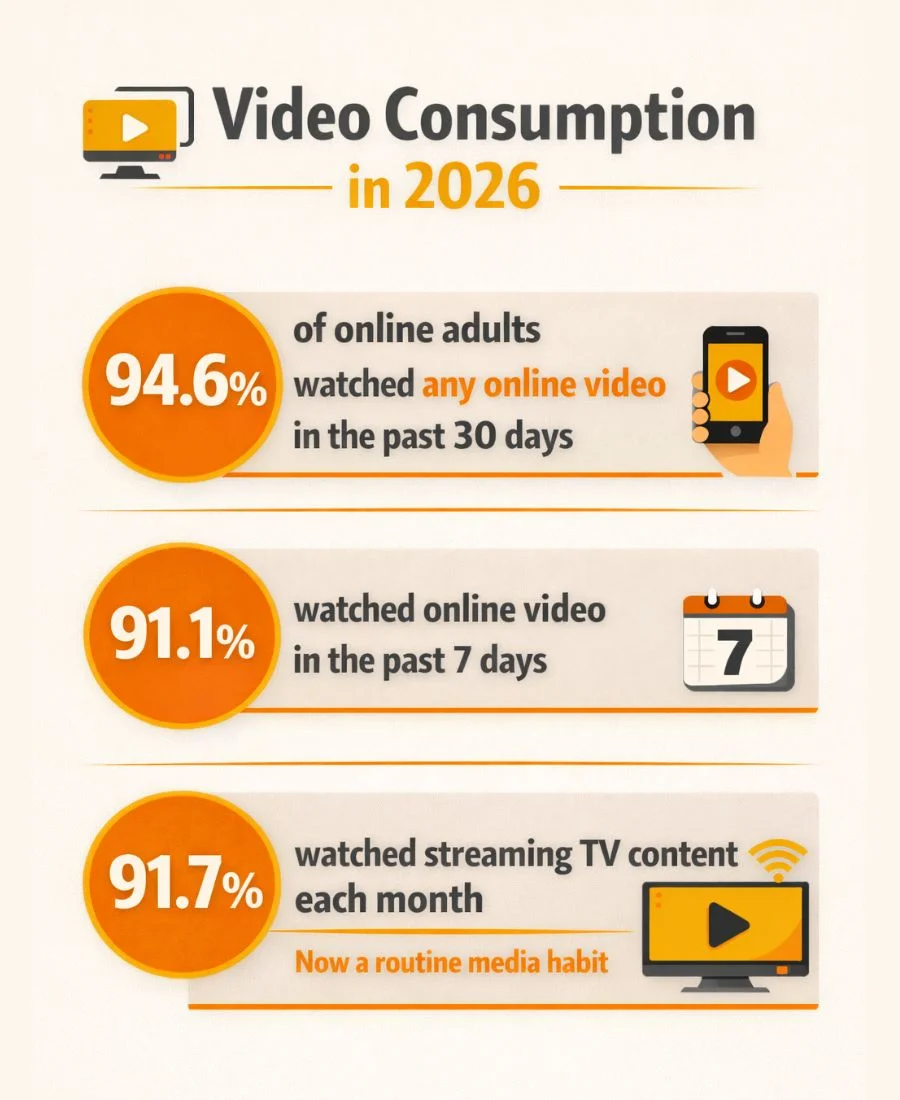
Start with the simplest reality: video is not “growing.” It’s already a default behavior for connected adults.
DataReportal’s Digital 2026 report (drawing on GWI insights) shows just how normalized this is:
Now zoom out to the size of the opportunity—and the competition. The 2026 report highlights that more than 6 billion people use the internet, and Kepios analysis estimates 73.2% of the world’s population is online. That scale matters because it means your videos are competing in a global, always-on attention market, where “good enough” production is less likely to stand out.
Within that attention market, time spent is consolidating into video-centric and feed-centric behaviors. The report indicates that women aged 16 to 24 spend 25 hours and 45 minutes per week scrolling social and video feeds—and that these feeds take up a meaningful share of connected time for the average online adult.
Platform time data also clarifies why “be everywhere” is not a strategy. They cite Similarweb’s App Intelligence (Android usage, August 2025) showing:
Your content plan should respect these different session behaviors:
One short-form stat underlines what “scale” really means in 2026: at Cannes Lions 2025, YouTube’s CEO said YouTube Shorts averages 200 billion daily views, up from the earlier 70-billion-daily-views milestone reported in 2024.
Key takeaway: In 2026, video marketing's goal is no longer to persuade viewers to watch videos. Instead, the focus is on capturing attention and building trust within already overcrowded feeds.
On the business side, the adoption curve is effectively mature.
According to Wyzowl's 2026 report, video remains central to business strategy, with 91% of businesses utilizing it as a marketing tool. Furthermore, 93% of video marketers consider it an essential component of their overall strategy.
The remaining “non-video” segment is shrinking, and the reasons they cite are revealing because they map directly to operational friction. Wyzowl reports the top two reasons for not using video are “not needed” and “too expensive” (both 24%), followed by lack of time (19%).
The budget intent is still strong: 92% of marketers plan to spend the same or more on video marketing in 2026, and 41% report spending money on video ads in the year captured by the survey.
When it comes to ROI, 82% of marketers say video marketing has given them a good ROI. This is down from the prior year’s peak (93%) in their tracking, but it remains a dominant majority, and it reinforces a practical truth: in 2026 you should treat video as a performance channel (measured and optimized), not just a brand channel.
Wyzowl also shows what marketers say video is doing across the funnel. In 2026, video marketers reported that video helped:
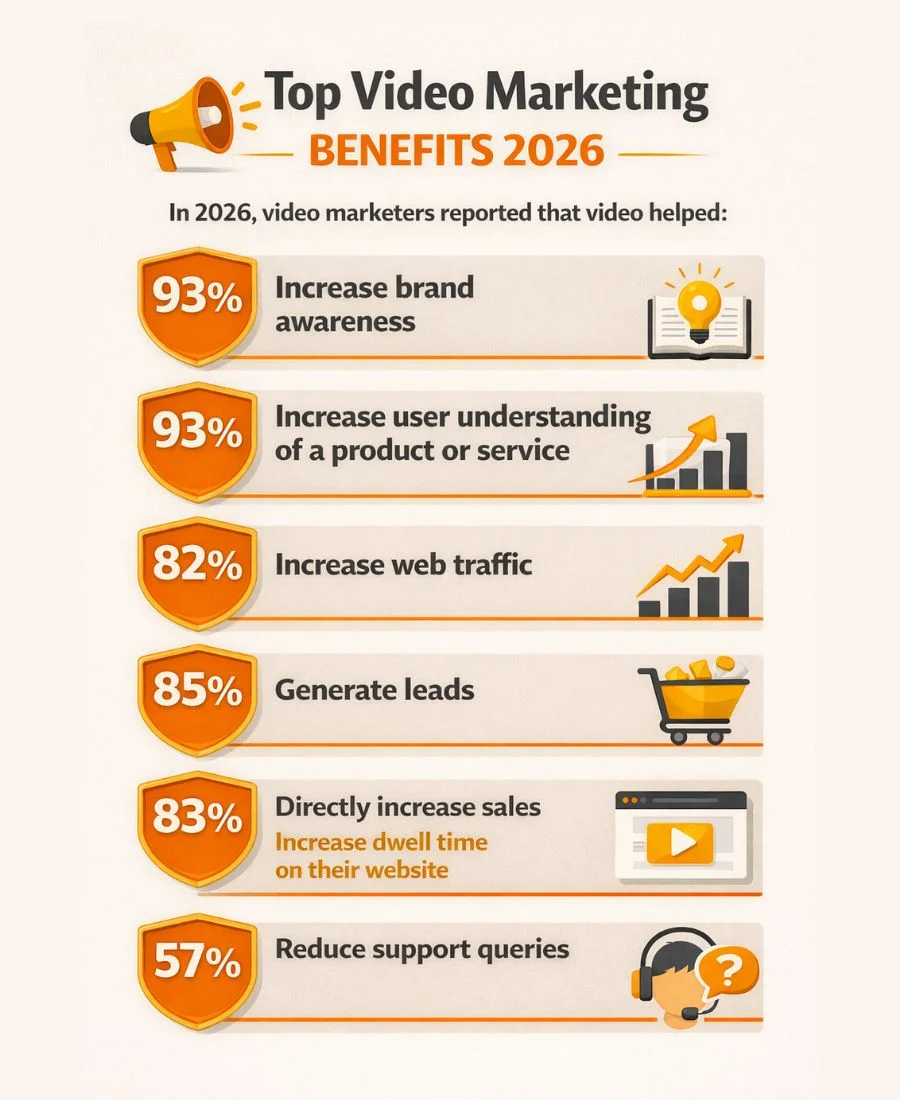
These are strong self-reported outcomes, but marketers still struggle with measurement maturity. Wyzowl reports that video marketers commonly quantify ROI using views (67%) and engagement such as likes, shares, and reposts (63%), followed by leads or clicks (52%) and bottom-line sales (32%).
This matters because the definition of a “view” is not consistent across platforms. For example, YouTube changed how it counts Shorts views starting March 31, 2025, aligning “views” with when a Short starts to play or replay, while continuing to track “engaged views” separately in analytics. That kind of platform-level metric shift can make year-over-year comparisons messy if you do not standardize your reporting.
The best argument for video is not “algorithms.” It is customer preference and conversion influence.
Wyzowl’s 2026 customer-view section reports:
Wyzowl’s trust statistic implies that as video becomes ubiquitous, production quality is no longer a nice-to-have. It is a conversion input because it shapes perceived credibility.
From a messaging standpoint, this is also why clear scripting and confident delivery are not cosmetic details. In a world where most consumers already use video to evaluate products, your on-camera clarity becomes part of the product experience.
A practical 2026 content plan needs two things: format choices that match the channel and length choices that match human attention.
Wyzowl’s 2026 report suggests a broad “sweet spot” for effectiveness: 71% believe videos between 30 seconds and 2 minutes are most effective.
However, “shortest” is not always “best,” especially for consideration-stage content. Wistia’s 2025 State of Video analysis (based on surveying 1,300+ professionals and analyzing 100 million videos uploaded to Wistia) emphasizes that engagement rate declines as videos get longer, but longer videos can still generate more total watch time.
Wistia’s benchmarks also show that for how-to videos under one minute, viewers watched an average of 82% of the video, and for how-to videos between 1 and 30 minutes, viewers watched over 50% on average. The implication is simple: if the content is truly useful, people will stay longer than marketers fear, but your value has to be obvious early. If not, they bounce.
Vidyard’s 2025 Video in Business Benchmark Report provides an additional length-retention anchor based on nearly 1 million B2B videos: if a video is under 1 minute, 65% of viewers stay engaged to the end, while for videos over 20 minutes, only 20% of viewers remain engaged through to the end.
That same Vidyard report documents that long content is not going away in business contexts: in 2024, Vidyard users created 420% more videos over 20 minutes, while videos under 3 minutes grew about 30%. This reinforces a modern reality of B2B and high-consideration buyer journeys: you need both snackable distribution content and longer decision support content.
Wistia’s findings also point to a conversion lever that many marketers underuse: interactivity. Wistia notes that the best way to convert a viewer is often to put an interactive feature directly into the video experience, and that certain long-form formats like webinars and original series can drive strong conversions, especially when lead gen forms are placed near the end.
Finally, do not ignore where video is being used the most. Wyzowl reports that social media videos were the most popular singular use case in 2026, with 69% of video marketers creating them.
A good 2026 strategy is not “pick one platform.” It is “understand what each platform is good for,” then make distribution choices that match your goals.
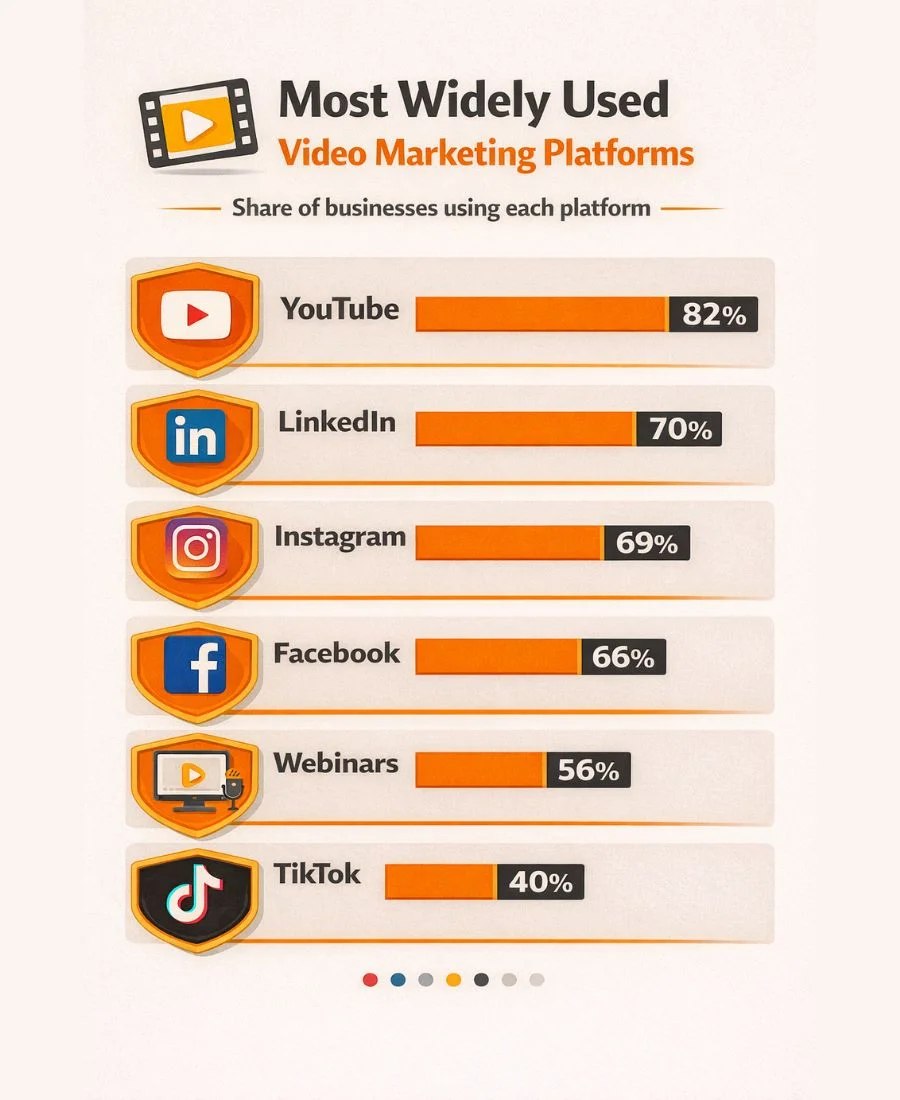
Wyzowl’s 2026 channel data provides a clean snapshot of what marketers actually use and what they consider effective:
The most widely used video marketing platforms (share of businesses using each) include YouTube (82%), LinkedIn (70%), Instagram (69%), Facebook (66%), webinars (56%), and TikTok (40%).
When asked which platforms are most effective, marketers ranked YouTube (69%) first, followed by Instagram (56%), Facebook (55%), LinkedIn (50%), and webinars (42%).
This split hints at a practical workflow many teams are moving toward: publish “evergreen plus search” on YouTube, distribute “snackable plus viral potential” on Instagram and TikTok, run credibility and lead capture via webinars, and use LinkedIn video for professional trust-building and B2B reach.
At the ecosystem level, Digital 2026 adds important context on device behavior and emerging inventory. DataReportal reports that YouTube’s own ad reach data indicates YouTube’s connected TV ad formats reach more than 4 in 10 users each month worldwide, and in the United States, marketers could reach 84.6% of YouTube’s total audience with CTV ads. This is a strong signal that “YouTube strategy” is no longer only mobile and desktop. It is also a living-room strategy, especially for brands that can benefit from high-impact screens and lean-back viewing.
Wistia’s distribution insights also reinforce that your website is still a key video destination. Wistia reports that social media and company websites are two of the most common places companies distribute videos, and it highlights that while home pages, product pages, and blogs are common placements, certain less common placements can perform strongly.
For example, Wistia notes that only a small share of companies place a video on their contact page, yet those pages can see high play rates. This suggests a “low competition” optimization play: place the right video where intent is highest, not only where traffic is highest.
Two macro forces are shaping video in 2026: budget migration into digital video advertising (especially CTV and social video), and rapid adoption of AI in both creative and workflows.
IAB’s 2025 Digital Video Ad Spend and Strategy report summary states that total U.S. digital video ad spend grew 18% year over year in 2024 to $64B and is projected to reach $72B in 2025, growing two to three times faster than total media.
IAB also points to a structural shift: its 2025 report positioning indicates digital video is set to capture nearly 60% of all U.S. TV/video ad spend in 2025, up from 29% in 2020.
Even if you are not running big paid campaigns, this ad-spend context matters because it reshapes competition. More money in video ads means higher creative volume, more A/B testing, and a higher bar for hooks, clarity, and production quality.
CTV is also becoming more performance-driven. Nielsen reports that 56% of marketers globally plan to increase spending on OTT/CTV in 2025, reinforcing that CTV is moving beyond “experimental branding” into a more standard part of the media mix.
On the marketing operations side, Wyzowl reports that 63% of video marketers have used AI tools to help create or edit marketing videos, up notably from the prior year in their tracking.
Wistia’s State of Video write-up similarly states that AI usage for video creation increased year over year in their survey, describing a jump from 18% to 41% of surveyed professionals using AI to create videos, with additional respondents planning to start soon.
Wistia’s 2026 AI Video Marketing Trends preview adds more tactical color:
On the advertising side, IAB’s July 2025 release states that 86% of buyers are using or planning to use generative AI to build video ad creative, and buyers project GenAI creative will reach 40% of all ads by 2026.
IAB also highlights how buying is evolving: buyers expect 47% of CTV inventory to be biddable (up from 34% the year before), and 74% have built or are planning to build internal teams to manage self-serve CTV activation in-house.
The strategic message across these datasets is consistent: AI is accelerating creative output and lowering production friction, but it also increases volume and competition. That makes your differentiation less about having video and more about having video that is clearer, faster to the point, and more trustworthy.
Statistics are only useful if they change behavior. Here is a practical, 2026-ready way to translate the data into an execution plan, especially if you create talking-head, demo, or educational videos.
First, align your video plan to the buyer’s learning preference. If 63% of consumers say they most want to learn about a product or service via a short video, you should treat short, clear videos as a core part of your product education system, not just as social content.
Second, invest in clarity and quality because trust is on the line. When 89% of consumers say video quality impacts trust, your production decisions affect conversion, not just aesthetics. This is where scripting and delivery become leverage: stronger structure, fewer filler words, and a confident run-of-show can make “simple” videos feel premium.
Third, adopt a two-speed content system:
Fourth, standardize measurement across platforms. Wyzowl shows that most teams still default to views and engagement as ROI proxies, but platform definitions of views can change, and view-based reporting can inflate without translating into pipeline. Build a metric stack that connects video to leads, conversions, and sales where possible, and keep platform view changes in mind when you report trends.
Fifth, use AI as a workflow multiplier, not a strategy replacement. With 51% of marketers ideating and scripting with AI and 63% of video marketers using AI tools for creation or editing, you should assume your competitors are also moving faster. Use AI to speed up scripting, outlines, and repurposing, then keep humans responsible for accuracy, brand voice, and on-camera credibility.
Finally, a simple execution checklist for 2026 video marketing: Write a script before you hit record, front-load the value in the first moments, keep most videos in the 30 seconds to 2 minutes range unless the content earns longer attention, publish consistently to the platforms that match your audience and goals, and measure beyond views to outcomes. This aligns directly with how consumers buy with video, how marketers report ROI, and how long viewers actually stay engaged.
Video marketing in 2026 is less about convincing people to press play and more about earning attention in crowded feeds. The strongest results come from getting the fundamentals right: choose formats that match the platform, lead with the clearest value in the first seconds, and publish with a consistent cadence. Use short-form to reach new audiences, then support real decisions with longer, helpful content like demos, explainers, and webinars.
AI is accelerating production and improving performance through practical upgrades such as scripting support, faster edits, and cleaner captions, but it does not replace strategy. Focus on clear messaging, strong distribution, and simple measurement tied to real outcomes. When you treat video as a system instead of a one-off asset, the stats stop being numbers and start becoming an advantage.
References:
Wyzowl: Video Marketing Statistics 2026
DataReportal: Digital 2026 Global Overview Report
TheWrap: YouTube Shorts Now Averages 200 Billion Daily Views
The Verge: YouTube Shorts will count views even if you scroll past
Wistia: State of Video Report: Video Marketing Statistics for 2025
Vidyard: Video in Business Benchmark Report AI Edition
IAB:
(1) 2025 Digital Video Ad Spend & Strategy Report: Part One
(2) 2025 Digital Video Ad Spend & Strategy Full Report
(3) Nearly 90% of Advertisers will Use Gen AI to Build Video Ads
Nielsen: Connected TV is transforming advertising


.png)


.png)